Understanding Student Development: A Guide to Educational Stages from Primary School to University
Education is not a monolithic experience; it is a dynamic journey that evolves significantly as children grow into young adults. Understanding the distinct phases of student development is crucial for parents, educators, and policymakers alike. From the curious primary pupil to the independent university student, each stage represents a unique set of cognitive, emotional, and social milestones. This article explores the different ages of students, examining the specific needs of growing boys and girls at various stages of education.
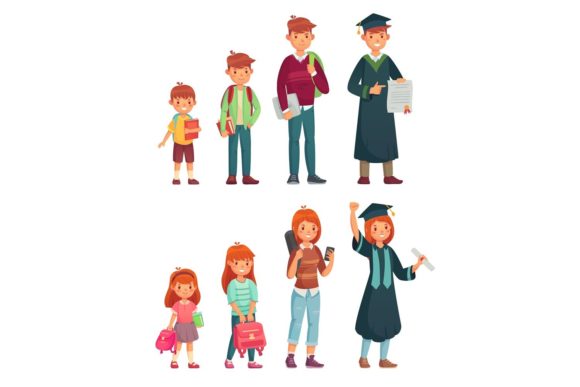
Visualizing these stages often helps in grasping the magnitude of change. Imagine a set of age grow cartoon vector isolated icons, where each icon represents a leap in maturity and capability. These visual metaphors remind us that while the goal remains learning, the methods and motivations shift dramatically over time. By breaking down these stages, we can better support learners in their academic and personal growth.
The Foundation: Primary Pupils and Early Childhood
The journey begins with the primary pupil. Typically ranging from ages five to eleven, this group is characterized by boundless curiosity and a fundamental need for structure. At this stage, education is less about specialized knowledge and more about acquiring basic literacy, numeracy, and social skills.
For growing boys and girls in primary school, the classroom is a microcosm of society. They are learning how to share, how to follow rules, and how to interact with peers outside their immediate family. The teaching style here is often holistic, integrating play with structured learning. Educators focus on building confidence and fostering a love for learning.
- Cognitive Development: Concrete operational thinking begins to emerge.
- Social Focus: Learning to cooperate and resolve conflicts.
- Key Challenge: Maintaining attention spans and developing routine.
It is a common misconception that primary education is merely "babysitting" with books. In reality, this is the most critical period for neural plasticity. The habits formed here—such as reading daily or asking questions—lay the groundwork for all future academic success.
Transitioning to Junior Levels
As students move into the junior years, often bridging the gap between primary and secondary education, they begin to seek more autonomy. This transitional phase is vital. Students start to develop individual interests and may show early signs of aptitude in specific subjects like science, arts, or languages.
During this time, the role of the teacher shifts from a caregiver figure to a mentor. Students are expected to take more responsibility for their homework and organization. For parents, this is a time to encourage independence while still providing a safety net. The importance of routine cannot be overstated here, as the workload begins to increase moderately.
Navigating Adolescence: Secondary and High School Kids
Secondary high school kids face perhaps the most turbulent yet transformative period of their educational lives. Spanning roughly from ages twelve to eighteen, this era is defined by puberty, identity formation, and increased academic pressure. The stakes feel higher as grades begin to impact future opportunities.
At this stage, the curriculum becomes specialized. Students no longer study general topics but dive deep into disciplines such as calculus, physics, literature, and history. This specialization allows them to explore potential career paths, but it also introduces stress. The social dynamics become complex, with peer influence often outweighing parental guidance.
- Identity Exploration: Teens ask, "Who am I?" and "Where do I fit in?"
- Academic Rigor: Standardized tests and college entrance exams become central focuses.
- Digital Integration: Technology plays a massive role in both learning and socializing.
It is essential to recognize that secondary education is not just about academic output. It is about developing critical thinking and resilience. Growing boys and girls at this age need support in managing anxiety and balancing extracurricular activities with study. Educators must create environments where failure is seen as a learning opportunity rather than a definitive judgment of worth.
The Role of Technology in Modern Secondary Education
In today’s context, high school education is inseparable from technology. Digital literacy is now as important as traditional literacy. Students use online platforms for research, collaboration, and submission of assignments. This shift requires a new set of skills, including information verification and digital etiquette. Understanding how to navigate the digital world safely is a crucial part of the modern secondary curriculum.
Higher Education: The College and University Student
The final stage in this continuum is the college university student. This group, typically aged eighteen and above, represents the transition into adulthood. Unlike previous stages, higher education is largely self-directed. There are no bells ringing to signal class changes, and attendance is often optional, placing the onus of responsibility squarely on the student.
University life is characterized by intellectual freedom and specialization. Students choose majors that align with their career aspirations. The learning environment shifts from rote memorization to analysis, synthesis, and creation. Professors act as guides rather than instructors, expecting students to engage in debate and independent research.
Beyond academics, university is a hub for networking and personal growth. Students learn to manage finances, live independently, and navigate professional environments through internships. This stage is crucial for developing the soft skills required in the modern workforce, such as communication, teamwork, and adaptability.
Visualizing Growth: The Value of Educational Icons
To better communicate these stages, designers and educators often utilize visual aids. For instance, a set of age grow cartoon vector isolated icons can serve as a powerful tool in presentations, textbooks, and educational apps. These icons provide a quick, universal understanding of the progression from childhood to adulthood.
If you are a content creator or educator looking to illustrate these concepts, having access to high-quality vector files is invaluable. Consider a product file that includes:
- One vector EPS10 file for scalability and editing.
- One JPEG 72ppi as a preview for quick reference.
Using a vector editor, such as Adobe Illustrator, allows you to customize these elements. You might want to separate elements to highlight specific traits of a primary pupil versus a university student. Or, you may wish to edit colors to match your brand identity. The flexibility of vector graphics ensures that your educational materials remain professional and engaging.
Why Customization Matters in Educational Content
Every educational context is unique. A rural school may have different needs than an urban university. By using editable vector assets, educators can tailor their visual materials to reflect their specific student demographics. This level of customization enhances relevance and engagement, making abstract concepts more tangible for learners.
Conclusion: Supporting Learners at Every Stage
From the eager primary pupil to the ambitious university student, each stage of education offers unique challenges and opportunities. Understanding these differences allows us to provide better support, whether we are parents, teachers, or designers creating educational resources. By recognizing the distinct needs of growing boys and girls at each level, we can foster an environment that promotes not just academic success, but holistic well-being.
Remember, education is a marathon, not a sprint. Each stage builds upon the last. By appreciating the journey and utilizing tools like customizable vector icons to communicate effectively, we can help students navigate their path with confidence and clarity. Whether you are designing a curriculum or simply supporting a child’s learning journey, keeping these developmental stages in mind will ensure a more effective and empathetic approach to education.