Strategic Visual Communication: Leveraging Education Roll-up Banner Post Templates for Modern Admissions
In the contemporary landscape of educational marketing, the battle for student attention is no longer fought solely on digital screens. While social media algorithms and search engine optimization dominate much of the conversation, physical presence remains a critical touchpoint for institutions ranging from local coaching centers to prestigious universities. At the heart of this tangible marketing strategy lies the Education Roll-up Banner Post Template, a design asset that has evolved from a simple printing utility into a sophisticated tool for brand storytelling and conversion.
For professionals, marketers, and entrepreneurs in the education sector, understanding the nuanced role of these templates is essential. They are not merely placeholders for text and logos; they are strategic interfaces between an institution’s value proposition and the prospective student’s immediate perception. As we approach new admission cycles, the integration of high-quality vector designs into physical marketing collateral reflects broader shifts in consumer expectations, workflow efficiency, and visual literacy.
The Evolution of Physical Marketing in a Digital Age
It might seem counterintuitive to emphasize physical banners in an era defined by virtual classrooms and online applications. However, the tangibility of print marketing offers a credibility that digital ads often struggle to achieve. When a parent walks into a coaching center or a student attends a university fair, the quality of the visual materials serves as a proxy for the quality of education provided. A poorly designed, pixelated banner suggests neglect, while a crisp, professionally structured Education Roll-up Banner Post Template signals competence, organization, and modernity.
This shift is driven by changing consumer behaviors. Today’s students and parents are visually literate. They are accustomed to the sleek aesthetics of tech giants and premium brands. Consequently, their expectations for educational institutions have risen. They demand clarity, aesthetic appeal, and immediate information accessibility. This is where the strategic use of vector templates becomes pivotal. Unlike raster images, vector-based designs ensure that every curve, line, and typography element remains sharp regardless of the print size, maintaining professional integrity across various mediums.
Why the New Year Admission Cycle Demands Precision
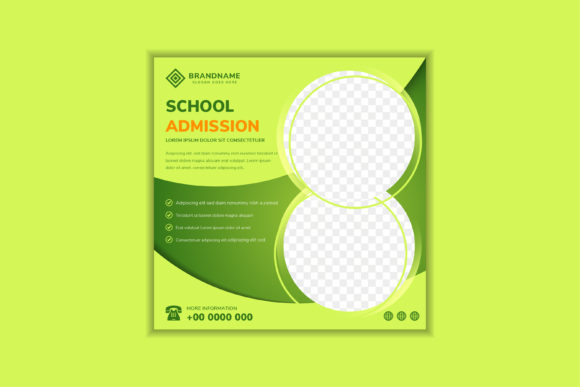
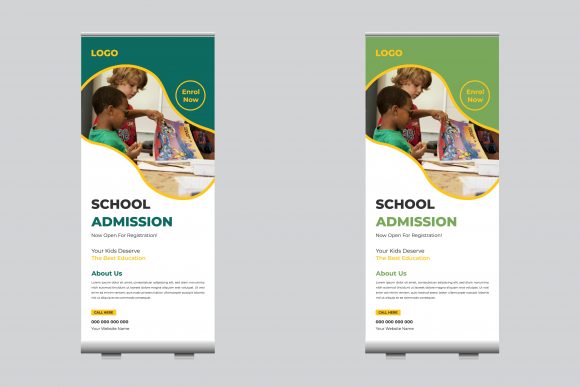
The start of a new academic year represents a peak season for educational marketing. During this period, the volume of competing messages is overwhelming. Institutions are vying for visibility in crowded halls, busy street corners, and community centers. In this high-noise environment, speed and consistency are paramount. This is why the New year admission roll-up banner post template has become an indispensable asset for marketing teams.
These templates are designed with the specific urgency of admission seasons in mind. They prioritize hierarchical information display, ensuring that critical details—such as application deadlines, key programs, and contact information—are consumed within seconds. For freelancers and designers working with multiple educational clients, having a robust library of these templates allows for rapid deployment without sacrificing customization. It bridges the gap between the need for speed and the demand for unique brand identity.
Aligning Design with Institutional Identity
A common misconception is that using a template results in generic output. On the contrary, a well-chosen Education Roll-up Banner Post Template provides a structural foundation that enhances brand consistency. For a university, the template might emphasize tradition, prestige, and campus life through serif typography and muted, authoritative color palettes. For a tech-focused coaching center, the same structural template can be adapted with bold sans-serif fonts, vibrant gradients, and dynamic geometric shapes to convey innovation and energy.
The versatility of vector templates allows marketers to align visual outputs with broader institutional goals. For instance, if a college is launching a new STEM initiative, the banner design can incorporate technological motifs and clean lines that reflect precision and future-readiness. This alignment ensures that the physical marketing material reinforces the narrative being pushed through digital channels, creating a cohesive omnichannel experience.
Workflow Efficiency for Creators and Entrepreneurs
For independent designers, marketing agencies, and educational entrepreneurs, time is a non-renewable resource. Creating a roll-up banner from scratch for every client or every campaign is inefficient and costly. By utilizing pre-designed vector templates, professionals can significantly reduce production time. This efficiency does not come at the expense of quality; rather, it allows creators to focus their energy on strategic customization rather than foundational layout construction.
Consider the workflow of a freelance designer managing five different coaching centers during admission season. Without templates, each project requires hours of layout planning, font pairing, and balance testing. With a standardized yet flexible Education Roll-up Banner Post Template, the designer can swap out branding elements, update copy, and adjust imagery in minutes. This scalability enables small businesses and solo practitioners to compete with larger agencies by offering faster turnaround times and consistent quality.
The Technical Advantage of Vector Formats
The preference for vector templates in professional printing is rooted in technical necessity. Roll-up banners are large-format prints, often exceeding six feet in height. Raster images (such as JPEGs or PNGs) can become pixelated when scaled up, resulting in blurry text and jagged edges. Vector files, typically in AI, EPS, or SVG formats, use mathematical equations to define shapes. This means they can be scaled infinitely without any loss of resolution.
For marketers, this technical detail translates to risk mitigation. It ensures that the final printed product matches the digital proof exactly, eliminating costly reprints due to quality issues. Furthermore, vector files are often smaller in size and easier to edit, making them ideal for collaborative workflows where multiple stakeholders may need to review and approve design changes.
Connecting to Broader Market Trends
The rising popularity of specialized design templates reflects a larger trend in the creative economy: the democratization of high-quality design. Tools and resources that were once exclusive to large corporations are now accessible to small coaching centers and individual educators. This democratization levels the playing field, allowing smaller institutions to present a professional image that competes with established universities.
Moreover, there is a growing emphasis on sustainability in printing. High-quality templates reduce waste by minimizing errors and reprints. When designers get it right the first time using a proven layout structure, less paper and ink are wasted. This aligns with the values of many modern educational institutions that prioritize environmental responsibility.
Practical Applications for Maximum Impact
To maximize the effectiveness of an Education Roll-up Banner Post Template, marketers should consider the context in which the banner will be displayed. Here are practical observations for different scenarios:
- University Fairs: Use templates with clear sections for program highlights and QR codes linking to virtual tours. The goal is to drive immediate digital engagement from a physical interaction.
- Coaching Centers: Focus on success metrics and testimonials. A template that prominently features student achievement stats can build trust quickly with skeptical parents.
- Open Houses: Utilize welcoming, warm designs that emphasize community and campus culture. The banner should serve as a photo backdrop, encouraging social sharing.
Each of these applications requires a slight adjustment in tone and layout, demonstrating the flexibility of a well-structured template system. The key is to maintain visual hierarchy, ensuring that the most important message is seen first, followed by supporting details.
Conclusion: The Strategic Value of Designed Presence
As the education sector continues to evolve, the tools we use to communicate value must also adapt. The Education Roll-up Banner Post Template is more than a design file; it is a strategic asset that supports brand consistency, operational efficiency, and effective communication. For professionals navigating the competitive landscape of new year admissions, investing in high-quality, versatile vector templates is a forward-looking decision.
By understanding the intersection of design, technology, and consumer psychology, marketers and creators can leverage these tools to create compelling physical narratives. In a world saturated with digital noise, the clarity and professionalism of a well-designed roll-up banner can make the decisive difference in attracting the next generation of students. The future of educational marketing is hybrid, blending the reach of digital with the resonance of the physical, and templates are the bridge that makes this integration seamless and successful.